
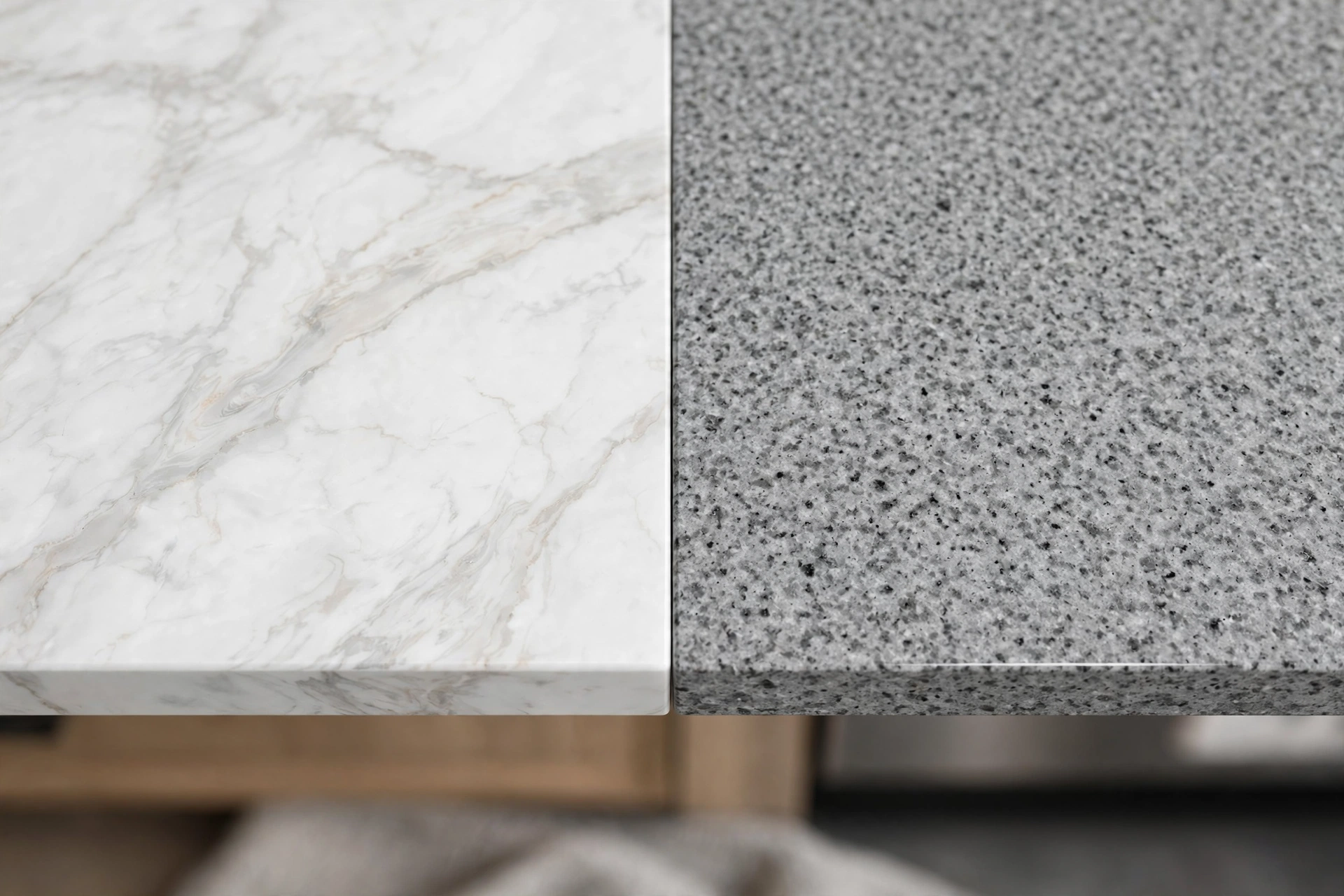
Quartz vs. Quartzite: Don’t Confuse These Two Stones
Quartz. Quartzite. The names sound nearly identical, and showroom conversations get tangled because of it — but these are two fundamentally different materials. Confusing them can lead to buying the wrong countertop for your lifestyle. Let’s clear it up for good.
The Fundamental Difference
Quartz countertops are engineered. They’re manufactured from roughly 90–93% crushed natural quartz stone mixed with polymer resins and pigments, pressed into slabs in a factory. Every slab is consistent, non-porous, and uniform by design. Brand names you may know: Cambria, Caesarstone, Silestone, MSI Q.
Quartzite is 100% natural stone. It starts as sandstone and, under intense heat and pressure over millions of years, metamorphoses into an extremely hard, dense natural stone that’s quarried in slabs like granite or marble. No factory, no resin — just geology.
Same root word, completely different product. Think of it this way: quartz is to quartzite what a photograph of a forest is to an actual forest. Related subject, different reality.
Appearance Differences
- Quartz (engineered): Consistent color and pattern from slab to slab. Modern manufacturing can mimic marble veining convincingly, but look closely and the pattern repeats — it’s printed precision, not nature’s randomness. The palette leans clean and contemporary: crisp whites, soft grays, solid blacks.
- Quartzite (natural): Every slab is one of a kind. It often delivers the soft, flowing veining people love in marble — whites, warm grays, subtle golds and taupes — with depth and variation no factory can truly replicate. If you want natural character, quartzite has it in spades.
If consistency and a perfectly uniform look matter to you, quartz wins. If you want a countertop nobody else on earth has, that’s quartzite.
Durability, Heat, and Stain Resistance
Hardness and scratch resistance: Quartzite is harder (7 on the Mohs scale) than engineered quartz (around 7 for the quartz crystals, but the resin matrix is softer). In practice, quartzite resists scratching and abrasion extremely well — but it can chip at edges if struck hard. Quartz is tough and slightly more forgiving of impacts because the resin gives it a touch of flexibility.
Heat tolerance: This is quartzite’s clearest win. As a natural stone, quartzite handles heat like granite — a hot pot set down briefly won’t damage it (though trivets are still smart). Engineered quartz contains resin binders that can scorch or discolor permanently under high heat. Never place a ripping-hot pan directly on quartz. This is the number-one practical difference in a real kitchen.
Stain resistance: Quartz wins here — it’s non-porous, so red wine, coffee, and turmeric wipe right off with no sealing ever needed. Quartzite is porous and must be sealed (typically every 1–3 years); a well-sealed quartzite resists stains excellently, but it demands that maintenance.
Maintenance Differences
- Quartz: The low-maintenance champion. No sealing, ever. Clean with mild soap and water. The only real rules: use trivets (heat!) and avoid harsh chemicals that can dull the resin.
- Quartzite: Maintain like granite — seal regularly (do the water test twice a year: if water stops beading, reseal), clean with pH-neutral soap, wipe spills promptly, and use trivets and cutting boards.
If you want a “set it and forget it” countertop, quartz is the answer. If you don’t mind the same care routine as granite, quartzite rewards you with natural beauty and superior heat tolerance.
Cost Comparison
In Metro Atlanta, installed prices typically run:
- Engineered quartz: $55–$90 per sq ft installed
- Quartzite: $70–$110+ per sq ft installed
Quartzite generally costs 10–20% more, reflecting quarrying difficulty and the skill required to fabricate such a hard stone. Within each category, premium colors and patterns push toward the top of the range.
How to Tell Them Apart When Shopping
Showroom labels aren’t always clear, and salespeople sometimes blur the lines. Protect yourself:
- Ask directly: “Is this engineered quartz or natural quartzite?” Get the answer in writing on your quote.
- Check the naming. Engineered quartz is sold under brand names (Cambria, Caesarstone, Silestone). Quartzite is sold by stone names (Taj Mahal, White Macaubas, Sea Pearl).
- Look at the back of the sample. Engineered quartz has a uniform manufactured backing; natural quartzite shows raw stone.
- Look for pattern repetition. If the veining repeats identically across a large sample, it’s manufactured quartz.
- Ask about sealing. If they say it never needs sealing, it’s quartz. If they recommend sealing, it’s quartzite (or another natural stone).
Which Should You Choose?
Choose engineered quartz if: you want zero maintenance, you love a clean consistent look, your household is hard on countertops (kids, red wine enthusiasts, turmeric-heavy cooking), and heat discipline (always using trivets) is realistic for you.
Choose quartzite if: you want the look of natural marble with far better durability, heat tolerance matters (you cook with cast iron, you set hot things down), you appreciate one-of-a-kind natural patterning, and you’re comfortable with periodic sealing.
There’s no wrong answer — only the wrong stone for your habits. Be honest about how you actually live in your kitchen, and the choice makes itself.
Still deciding? Come see both in person at Royal Granite Creations’ Powder Springs showroom — you can compare engineered quartz and natural quartzite side by side and handpick your slab. We fabricate and install granite, quartz, quartzite, and marble countertops in-house across Metro Atlanta. Call (678) 653-7101 for a free estimate.