
Honed vs. Polished Granite: Which Finish Is Right for You?
When you’re choosing granite, most of the attention goes to color and pattern — but the finish changes the stone’s look, feel, and maintenance just as much. The two main options are polished (glossy) and honed (matte). Neither is better in absolute terms; they’re different tools for different jobs. Here’s how to pick.
What Each Finish Actually Is
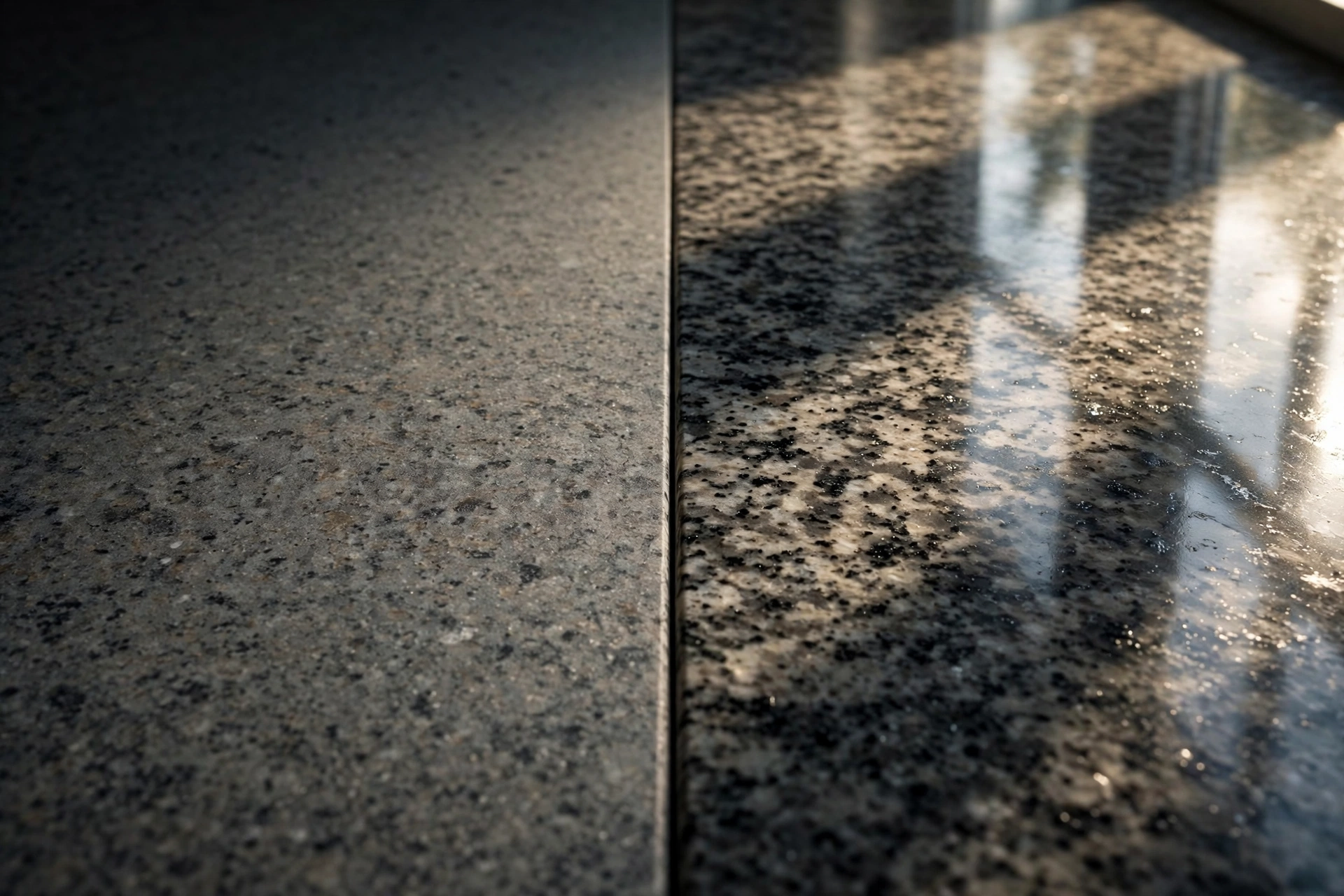
Polished granite is the finish you picture when you think of granite countertops: glossy, reflective, mirror-like. It’s achieved by grinding the stone with progressively finer diamond abrasives until the surface reflects light. The polishing process closes the stone’s surface pores, which is why polished granite is the most stain-resistant form of the stone.
Honed granite stops the grinding process earlier, leaving a smooth but matte, satin-like surface with no shine. It feels soft and velvety under your hand — many people describe it as more “natural” or “organic” feeling. Honing doesn’t remove material unevenly or make the stone rougher; it’s perfectly smooth, just not reflective.
Some fabricators also offer a leathered finish (textured, with a slight sheen) — think of it as honed’s rustic cousin. This article focuses on honed vs. polished, the two most common choices.
Look and Feel
Polished makes colors pop. Dark granites look deeper and richer polished; light granites gain contrast and drama. The gloss reflects light around the room, which can make a smaller kitchen feel brighter. It’s the classic, formal, “granite countertop” look.
Honed mutes the color slightly — the same slab looks a touch softer and less saturated. Veining and movement read more subtly. The overall effect is understated, modern, and relaxed: think farmhouse, contemporary, or minimalist kitchens. Honed stone doesn’t reflect overhead lights, so it photographs beautifully and avoids glare.
Run your hand across both at a showroom. The difference in feel is immediate, and most people know within seconds which one they prefer touching every day.
Fingerprints, Smudges, Scratches, and Crumbs: The Honest Scorecard
This is where the finishes diverge most in daily life:
Fingerprints and smudges:
- Polished shows them more. Oils from your hands create visible smudges on a glossy surface, especially on dark colors. You’ll find yourself wiping more often.
- Honed hides them better. The matte surface doesn’t reflect light the same way, so fingerprints and water spots are far less visible. A busy family kitchen stays looking cleaner between wipe-downs.
Scratches:
- Polished hides light scratches better — the gloss distracts the eye, and the harder, closed surface resists them in the first place.
- Honed shows scratches more. On a matte surface, a scratch catches light differently than the surrounding stone and stands out. Light-colored honed granite hides this best; dark honed granite shows every mark.
Crumbs and dust:
- Honed wins here too. Crumbs and dust are less visible on a matte surface. On polished dark granite, every crumb announces itself.
Stain Resistance: Sealing Matters More on Honed
Here’s the technical difference that matters: honing leaves the stone’s pores slightly more open than polishing does. That means honed granite is a little more absorbent — oil, wine, and coffee can penetrate slightly faster.
The fix is straightforward: seal honed granite diligently. Use a premium penetrating sealer, and do the water test (sprinkle water; if it soaks in instead of beading, reseal) twice a year. A well-sealed honed countertop performs excellently — it just has less margin for neglect than polished stone. If you’re the type to wipe spills within minutes, you’ll never notice the difference. If spills tend to sit, polished is more forgiving.
Maintenance Differences at a Glance
- Polished: Wipe fingerprints more often; seal every 1–3 years; scratches less of a worry; use pH-neutral cleaner.
- Honed: Wipe less often for smudges; seal on the shorter end of the range (every 1–2 years); be a bit more careful about sliding rough ceramics; use pH-neutral cleaner.
Cleaning products are the same for both: warm water, mild dish soap or pH-neutral stone cleaner. Never vinegar or abrasive pads on either finish.
Which Rooms and Applications Suit Each Finish?
Choose polished for:
- Kitchens where you want maximum stain resistance and a classic look
- Smaller or darker kitchens that benefit from reflected light
- Bathroom vanities (polished handles cosmetics and water spots well)
- Households that prioritize low-maintenance over low-smudge
Choose honed for:
- Kitchens with a modern, farmhouse, or minimalist design
- Busy households that hate visible fingerprints (kids’ handprints show far less)
- Matte black or dark design schemes where gloss would clash
- Fireplace surrounds and accent walls where glare is unwanted
- Anyone who loves the soft, natural feel of matte stone
A popular compromise: polished on the kitchen island (the showpiece) and honed on the perimeter counters, or vice versa. Mixed finishes are a legitimate design choice, not a mistake.
Can You Change the Finish Later?
Yes — and this surprises a lot of people. A stone professional can hone a polished countertop (matte it down) or repolish a honed countertop (bring back the gloss) right in your kitchen. It’s a refinishing process using diamond abrasives, similar to how the finish was created at the fabricator.
A few realities to know:
- It’s a professional job, not DIY. Doing it by hand gives uneven results; pros use weighted floor-style machines with water feed.
- Repolishing removes a tiny amount of material, so it can only be done a limited number of times over a countertop’s life. Honing is gentler.
- After refinishing, the stone must be resealed.
- Cost is typically a few hundred dollars for an average kitchen — far less than replacement.
So if you choose polished and later wish you’d gone matte (or the reverse), you’re not stuck. The stone is the same; only the surface treatment changes.
The Decision in One Paragraph
Pick polished if you want the classic glossy look, maximum stain resistance, and don’t mind wiping fingerprints. Pick honed if you love the soft matte aesthetic, want to hide smudges in a busy household, and will keep up with sealing. Either way, you’re getting the same tough, beautiful granite underneath.
Want to feel the difference in person? Visit Royal Granite Creations’ Powder Springs showroom to run your hand across honed and polished samples side by side. We fabricate and install granite, quartz, quartzite, and marble countertops across Metro Atlanta, in whatever finish fits your kitchen. Call (678) 653-7101 for a free estimate.