
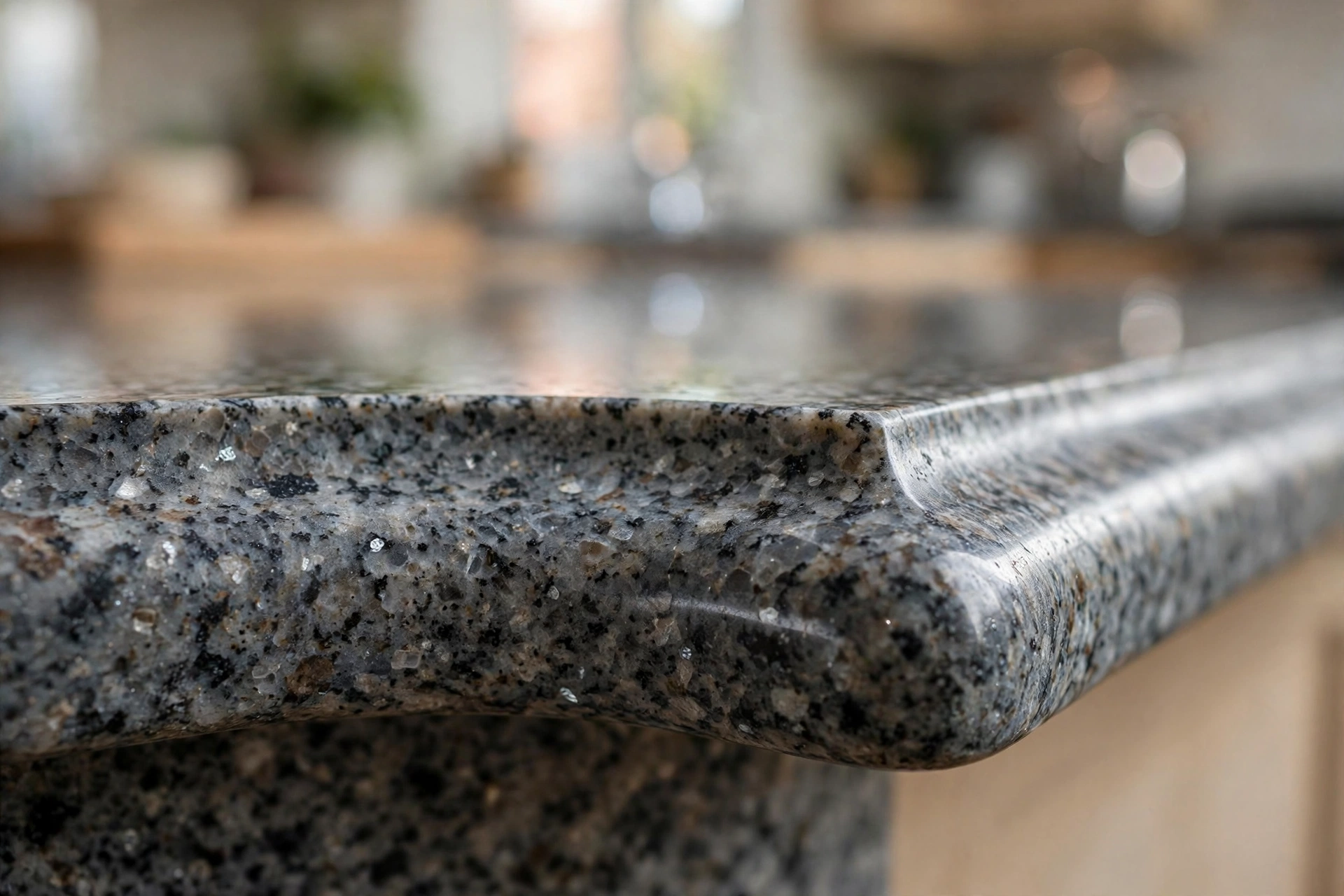
Granite Edge Profiles: From Eased to Ogee
The edge profile — the shape of your countertop’s finished edge — is one of the smallest details in a kitchen remodel and one of the most visible. You’ll see and touch it every single day. It affects the style of the room, the cost of the job, and even how safe the edge is for small children. Here’s a plain-English guide to every common profile so you can choose with confidence.
The Simple, Standard Profiles
Eased edge: The edge is squared off with just the sharp corner softened. Clean, minimal, and modern — and it’s the standard profile included in most quotes, so there’s no upcharge. If you love contemporary kitchens, eased is probably your answer.
Bevel edge: A flat 45-degree cut along the top of the edge. Slightly more detail than eased while still reading modern and crisp. Usually a modest upcharge over standard.
Half bullnose: The top half of the edge is rounded while the bottom stays squared. Softens the look, feels good to lean against, and still shows a defined edge line. A small upcharge.
Full bullnose: The entire edge is rounded into a half-circle. The softest, most forgiving profile — no sharp anything. Classic in traditional kitchens and the safest choice around toddlers. Small to moderate upcharge.
The Decorative Profiles
Ogee edge: An S-shaped curve — concave scoop flowing into a convex round. Elegant and formal, the ogee is a staple of traditional and luxury kitchens. It shows off the stone’s depth and pattern beautifully. This is an upgraded profile with a real cost bump, since it takes more fabrication time.
Dupont edge: A variation with a sharper, more defined notch near the top of the edge. Dressy without being quite as ornate as ogee. Similar upcharge territory — a premium profile.
Chiseled (rock-faced) edge: The edge is broken by hand or tool to look rough and natural, like split stone. Rustic, Old World, farmhouse, Tuscan — this profile is all about texture. It’s labor-intensive, so expect a premium price, and note that the rough surface can be harder to wipe clean.
Waterfall and Mitered Edges
Mitered edge: Two pieces of stone joined at 45 degrees to create the look of a thick slab (often 2 inches or more) from standard 3cm material. Dramatic and modern — a thick edge makes a strong statement on islands.
Waterfall edge: The countertop material continues down the side of the island or peninsula to the floor. Stunning on islands, especially with veined stone where the pattern can be book-matched down the side. This is a premium feature — it uses significantly more material and fabrication time — but it’s the single most dramatic edge treatment available.
How Profiles Affect Cost
Here’s the honest breakdown: eased is typically included in your base price. Everything else adds labor, and labor costs money. Simple rounded profiles (half bullnose, full bullnose, bevel) add a modest per-linear-foot upcharge. Decorative profiles (ogee, dupont, chiseled) cost meaningfully more. Waterfall and mitered edges are priced per project because of the extra material and shop time.
When comparing quotes, always ask which profile is included — a quote that looks cheaper may be pricing a basic edge while another includes the ogee you actually want.
Practical Notes: Beyond Looks
Drip control: Eased and bevel edges let water run straight off the front — fine on a counter, but consider that over an open cabinet face. Bullnose profiles encourage water to drip from the rounded bottom, slightly away from the cabinet.
Crumb catching: Decorative profiles with grooves and curves (ogee, dupont) collect crumbs and grime in their details. They’re not hard to clean — just run a cloth along the profile — but simple edges are genuinely lower-maintenance.
Child safety: If you have toddlers learning to walk, full bullnose is the kindest profile in the business. Eased and mitered edges are the sharpest. Decorative profiles fall in the middle. This alone decides the question for many young families.
Durability: Sharp, thin edges chip more easily than rounded ones. If your household is rough on things, a bullnose or eased edge holds up better than a delicate ogee overhang.
How to Choose
- Start with your kitchen style. Modern and minimalist: eased, bevel, or mitered. Traditional and formal: ogee, dupont, or full bullnose. Rustic and farmhouse: chiseled or half bullnose.
- Check your budget. Know the upcharge before you fall in love with an ogee. Ask your fabricator for per-linear-foot pricing on each profile.
- Think about daily life. Kids? Go rounded. Hate cleaning grooves? Keep it simple. Want a showpiece island? Waterfall.
- Feel the samples. Edge profiles are tactile. Visit the showroom, run your hand along the samples, and lean against them. The one that feels right usually looks right too.
There’s no universally “best” edge — there’s the best edge for your kitchen, your budget, and your life. A good fabricator will talk you through the trade-offs honestly rather than upselling the fanciest option.
At Royal Granite Creations, we fabricate every edge profile in-house at our Powder Springs shop — eased to ogee, bullnose to waterfall — for granite, quartz, quartzite, and marble installations across Metro Atlanta. Come feel the profiles in person, or call (678) 653-7101 for a free estimate.