
How to Remove Water Rings and Hard Water Spots from Granite
How to Remove Water Rings and Hard Water Spots from Granite
You set a glass down, pick it up an hour later, and there’s a pale ring staring back at you. Or you notice chalky white spots building up around the faucet. Before you panic, here’s the reassuring truth: most water marks on granite are sitting on the surface, not in the stone — and surface deposits are very fixable. The trick is starting gentle and knowing when a “water spot” is actually something else.
What’s Actually Causing the Mark
There are two completely different things people call “water spots,” and they need different treatments:
Mineral deposits (the common one). Hard water contains dissolved calcium and magnesium. When water evaporates off your countertop, it leaves those minerals behind as a whitish film, ring, or spot. This is a deposit on top of the stone and sealer. It’s cosmetic, and it comes off.
Etching (the serious one). Etching is actual chemical damage to the stone’s surface — a dull spot where acid has eaten into the finish. On granite this is uncommon (granite resists acids well), but it happens when harsh acidic cleaners, rust removers, or strong descaling products sit on the stone. Etching doesn’t wipe off; the surface itself is altered. More on this below.
How to tell them apart: run your fingernail lightly across the mark. If you feel a slight raised or crusty texture, it’s a deposit. If the surface feels smooth but looks dull or lighter, suspect etching.
Method 1: Damp Microfiber Buffing (Start Here)
For fresh, light rings, this is often all you need:
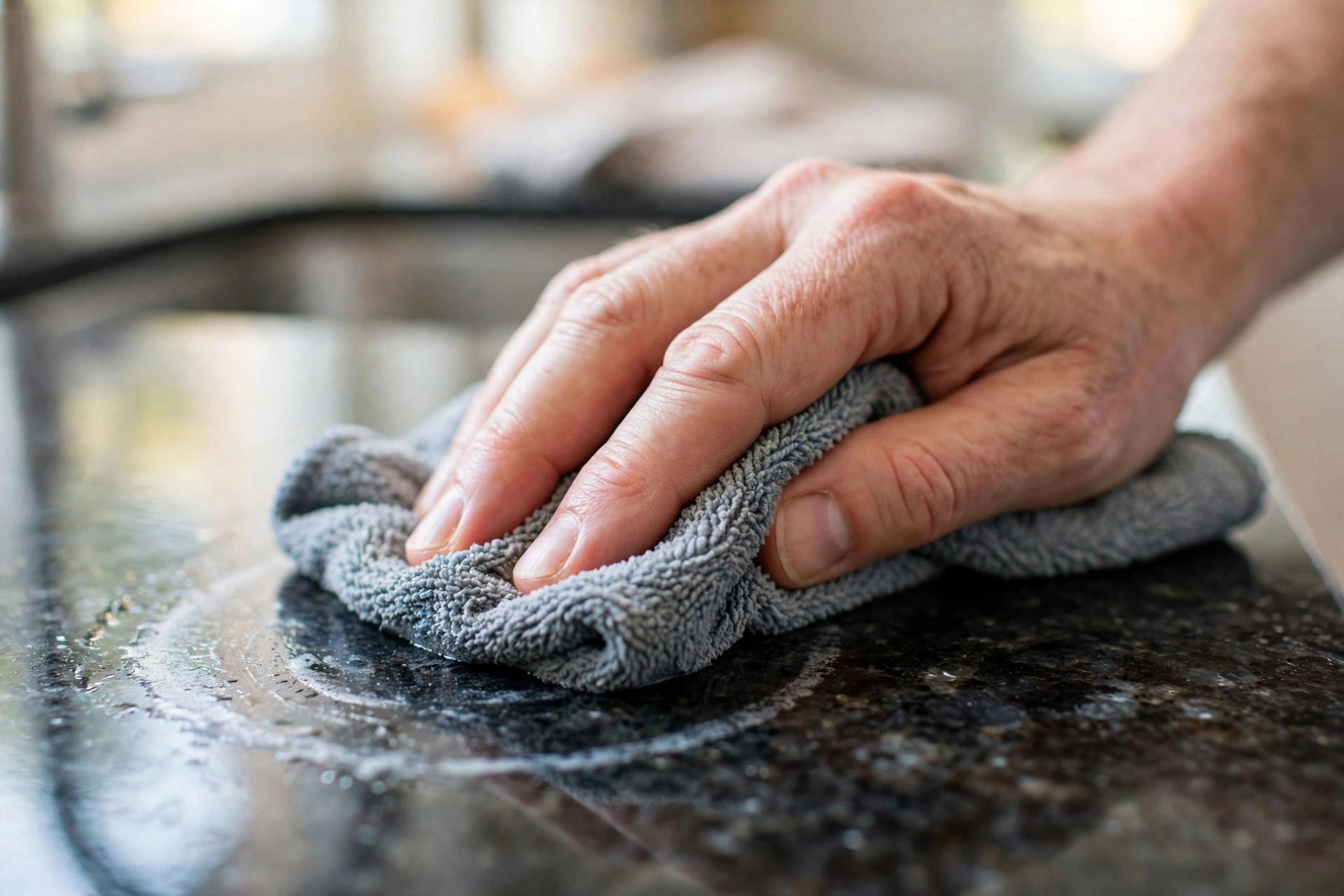
- Dampen a clean microfiber cloth with warm water (wring it well — damp, not dripping).
- Buff the ring with firm, circular pressure for 30–60 seconds.
- Flip to a dry section of the cloth and buff dry.
Fresh mineral rings frequently disappear with nothing more than this. If the ring lightens but doesn’t vanish, move to Method 2.
Method 2: Baking Soda Paste (for Stubborn Rings)
Baking soda is mildly abrasive — gentle enough for polished stone when used correctly — and it lifts mineral deposits effectively:
- Mix baking soda with a few drops of water into a thick paste (peanut-butter consistency).
- Apply the paste to the ring with a soft cloth, using light circular motions. Let the paste do the work — don’t bear down hard.
- Work the area for a minute or two, then wipe clean with a damp cloth.
- Buff dry with microfiber and check. Repeat once if needed.
This handles the vast majority of water rings. If two rounds don’t clear it, the deposit may be layered — move to a stone-safe mineral deposit remover rather than scrubbing harder.
Method 3: 0000 Steel Wool with Water (Cautious Option)
Extra-fine 0000-grade steel wool (the finest grade sold — it feels soft, almost like cotton) can remove stubborn mineral buildup from polished granite when used with water as a lubricant. But treat this as a last resort before chemicals, not a first step:
- Use only 0000 grade — coarser grades (0, 1, 2) will scratch.
- Keep the surface wet the entire time. Dry steel wool on dry stone is asking for scratches.
- Use light pressure and small circles, checking your progress every 15–20 seconds.
- Never use this on honed granite. The matte finish shows micro-scratching far more readily than polished stone. On honed surfaces, skip straight to a chemical mineral remover.
- Stop immediately if you see any change in the stone’s sheen beyond the spot you’re treating.
Honestly? Most homeowners never need this step. Methods 1 and 2 plus a good mineral remover cover nearly everything.
Method 4: Stone-Safe Mineral Deposit Removers
For heavy buildup — the crusty white ring around a faucet base that’s been growing for months — a commercial mineral deposit remover formulated for natural stone is the right tool. Look for products labeled “safe for natural stone” or “pH-neutral mineral deposit remover” from stone-care brands.
- Apply according to the product’s directions (usually a few minutes of dwell time).
- Agitate gently with a soft cloth or non-scratch sponge.
- Rinse thoroughly and dry.
What makes these safe is what’s missing: no harsh acids. Which brings us to the important part.
What NOT to Do
Never use vinegar. We say this in nearly every article because it’s the most common mistake. Vinegar is acidic — it dissolves mineral deposits, yes, but it also dissolves the sealer protecting your granite, and with repeated use it can etch the stone itself. The cure becomes worse than the disease.
No acidic descalers or lime removers. Standard bathroom lime-scale removers (the kind you’d use on a showerhead) are far too aggressive for natural stone. If the label doesn’t say safe for natural stone, don’t use it on natural stone.
No abrasive pads. Green scouring pads, powdered cleansers, and stiff brushes scratch polished granite and create micro-abrasions that trap future deposits — making the problem worse over time.
No bleach. It doesn’t remove mineral deposits anyway, and it can discolor stone and degrade sealer.
When a “Spot” Is Actually Etching
If gentle methods and a stone-safe remover don’t touch the mark, and the surface feels smooth but looks dull, you’re likely looking at etching — chemical damage, not a deposit. On granite, this usually comes from an acidic cleaner someone used (often unknowingly) rather than from water itself.
Etching can’t be wiped or dissolved away because the stone’s surface is physically altered. Light etching can sometimes be improved with a granite polishing compound and patient hand-buffing. Moderate to severe etching — or etching spread over a large area — needs professional repolishing, where a stone pro re-hones the surface with diamond abrasives and restores the finish. It’s very fixable; it’s just not a DIY cleaning job.
Prevention: Keep the Rings from Coming Back
- Use coasters. The simplest fix. Coasters under glasses — especially in hard-water areas — eliminate 90% of water rings.
- Wipe up standing water. Don’t let puddles sit and evaporate on the stone. This matters most around the sink, under dish racks, and beneath pet bowls.
- Dry around faucets and sinks. A quick wipe of the faucet base and sink edge as part of your routine prevents the slow mineral creep that becomes crusty buildup.
- Squeegee the sink area. Keep a small squeegee or dedicated hand towel by the kitchen sink and make it a habit.
- Keep your sealer fresh. Do the water test twice a year — sprinkle water on the stone; if it beads, you’re protected; if it soaks in and darkens, reseal. A healthy sealer keeps minerals sitting on the surface (where they wipe off) instead of bonding to the stone.
- Consider your water. If your home has very hard water, a water softener reduces spotting on every surface in the house — countertops included.
Water rings look alarming but they’re one of the easiest countertop problems to solve. Start with a damp microfiber cloth, escalate only as far as you need to, keep acids far away from your stone, and you’ll have it handled in minutes.
Dealing with a mark that won’t budge, or suspect etching that needs professional attention? Royal Granite Creations has fabricated and installed granite, quartz, quartzite, and marble countertops across Metro Atlanta since 2015 — and we restore stone too. Call (678) 653-7101 for a free estimate.